
The Crow's Mask
A cautionary tale from the Shadow World, where the veil between the living and the dead is at its thinnest.

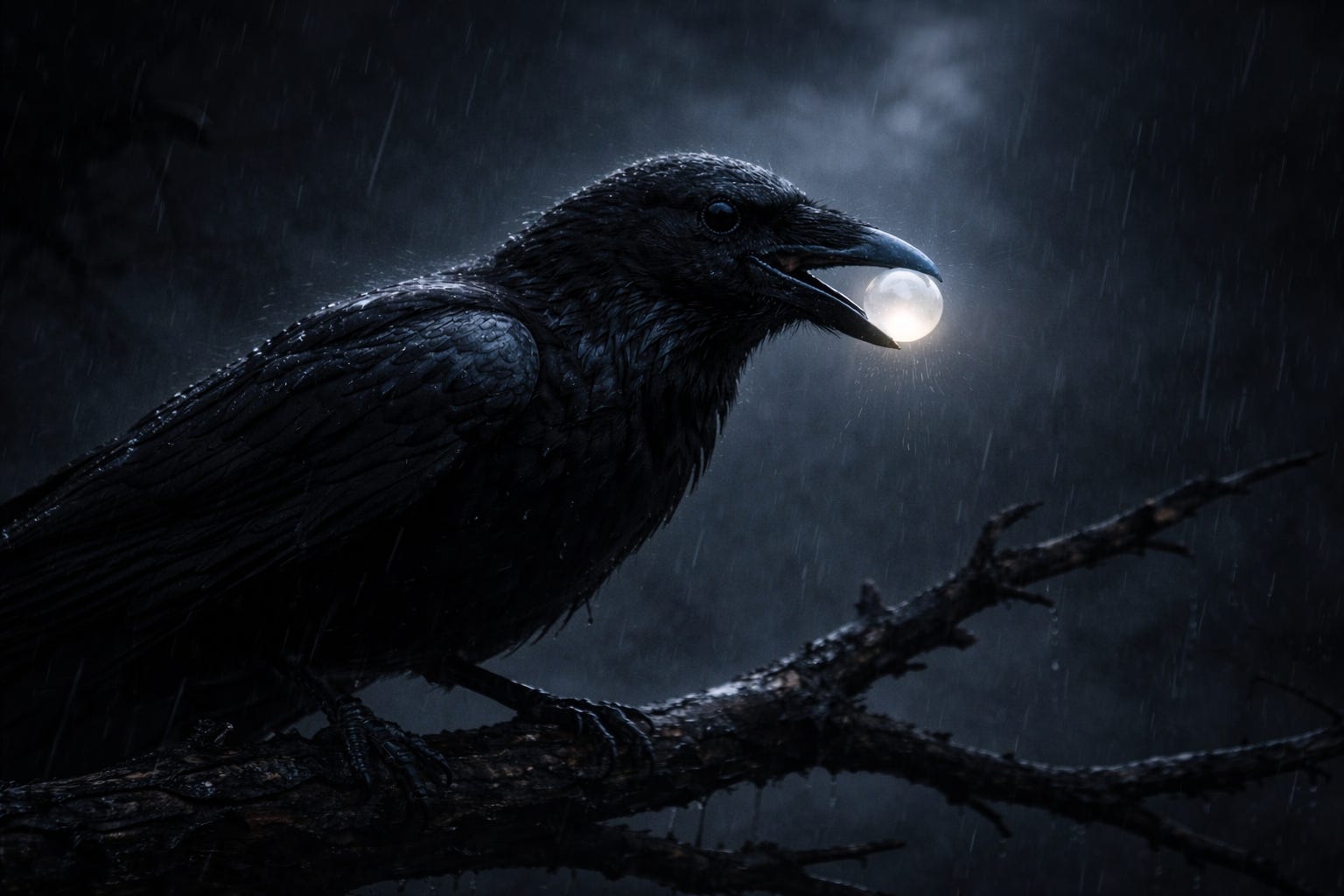
For more than thirty-five hundred years, the crow (Corvus) has borne witness to mankind as starmap and companion to Hydra (the serpent) and Crater (the cup). For the ancient Mesopotamians, this triad of constellations formed a cluster in the southern sky that symbolized death, a marker of the gateway to the Land of the Dead.
As centuries passed, the crow would be given many names and roles by the world’s peoples. Messenger of the gods. Keeper of memory. Battlefield witness. Carrier of prophecy. Symbol of transformation through destruction. Trickster. Survivor. A creature said to walk the boundary between the lands of the living and the dead. In this tale told in dark and shadow, the crow who answers to every mantle is known as Morrígan.
In ancient Celtic mythos, Morrígan exists as the divine presence of war and fate. She is observer, not decider, of who dies and who lives on the battlefield. She often arrives on the battlefield in the form of the crow before blades are wielded, as they rise, and remains after they fall to mark the dead and ease their passage. Even before war is waged, she may appear to the hero as an omen, a warning, a test, or a challenge.
When in the form of the crow, she too remembers all the faces on the battlefield, those who have helped and those who harmed, held in her sight for all time. And like the crow, she holds grudges against those who have trespassed beyond pardon and offers small gifts to those she deems worthy. As a transitory, eternal being whose role is keeper of consequence on the edges of life and death, she moves between both lands, at times carrying tortured souls with her from one realm to the next.
And still, Morrígan continues her watch. Not only over the ancient battlefields and fallen kingdoms of the distant past but over modern cities of brick and wire, where street lights flicker instead of torches, and the cost of living is measured not in grain or tribute, but in rent.
She watches where people make homes inside what has been allowed to decay. Where broken things are ignored rather than repaired. Where spaces of the more unfortunate are emptied by pressure rather than care, and neglect becomes a tool. What could be restored is instead permitted to disappear, because it costs the system less to erase people than to make things right.
In one such structure, repairs are requested, delayed, and unanswered. Eviction notices arrive instead. The tenants’ voices rise, then soften to shared whispers as the rent is still collected at the beginning of each month. The system treats the building as though it is already gone, even as people continue to live inside it.
Among those living there are two who have not yet learned the true cost of being heard. They refuse to leave quietly and let their home be reduced to rubble. They insist it should be made livable again. Through repair. Through restoration. Through justice. They believe that neglect is something that should be challenged and that dignity is not reserved only for those with influence. They demand what so many others, paying the same rent, receive without question. Permanence. Safety. Community. Their voices remain strong. Others, stirred by their courage, begin to raise their own.
But the world rarely answers such requests with change. Change is costly, inconvenient, and disruptive to the system.
Fear is cheaper. Fear travels faster, settles deeper, and teaches others to remain quiet. Another night descends, and as the crow arrives as witness, this becomes their final lesson.
As the two are taken through violence and unpardonable trespass, Morrígan stands as witness and remembers the faces of those taken and those responsible alike. She has watched similar exchanges before across time. Voices rise and the system answers with correction instead of justice.
When their neighbors later discover their fate, they too learn the same lesson. Go quietly. Disappear. And continue to pay what is owed.
Without Morrígan, our story would have ended there, but as the keeper of consequence, there are debts that are not allowed to settle into silence. Instead of releasing the tortured soul and easing his journey, human pain and the crow's instinct collide in her presence. Grief meets memory, and neither yields. Both lock into place, binding one to the other.
The hands of time in our story move forward to the hour of his death and the veil between the living and the dead thins once again. His soul, still bound to Morrígan, returns with her to the vessel that lays buried and waiting. In that second binding, the crow’s grudge takes living form.
Pain is the first thing that returns. Not memory. Not purpose. Pain, and the sense that something important remains unfinished. The wounds that took his life become as transient as the crow that watches over him. In this new binding, the grudge holds the pain, the crow the memory. And as one, they return to a world where time continued its march forward. They move not to restore what was lost, for that moment passed long ago. They move not to rebuild what has already been taken. They move only to see the trespass answered and consequence fulfilled.
The grudge returns to what once held light, laughter, and love. While the city and its people are carried forward, only his home remains unchanged by time. What the fire spared lies forgotten, left to collect dust until he reclaims it. Faded photographs. A ring that still shines. The eternal frown of a black and white mask that holds the memory of a better time. Photographs are burned. The ring he keeps with him. The mask he embodies.
With black and white paint, the grudge covers his face in the mask of the dead. A mask that the living never see once a soul is lost to them. A mask not chosen, but revealed as he works. It stands as record. Of unseen injuries taken. Of the quiet consequences returned.
This is the face he wears when he steps back into time. It is the last thing that those who have trespassed witness before they don their own. Violence is paid forward. Paid in blood. Retribution though pain. Balance restored in loss. And with each debt collected, the ledger shifts and the rain washes the paint away.
One by one, the noise of grievance grows quieter until only the grudge remains. The names are crossed out. Accounts answered. Not restored. Not redeemed. Only settled.
When the ledger is finally balanced, the crow’s grudge is allowed its rest. His love appears, her touch light on his shoulder. In that touch, the man he was is reminded of better times, and Morrigan once again becomes the sole keeper of what was lost. She returns the last token to the living, and with that final act, the remaining threads of the binding give way, freeing her.
Morrigan takes flight, over the city, its people, and the system that continues to collect what is due even when consequence intervenes. She passes the the hollow derelict of an empty building that will never see repair. Still standing. Still forgotten. Still decaying. The lives taken there remain lost. The structure remains as do the conditions that sealed its fate.
Her gaze falls on one man in the street below stabbing another for the rent in his wallet. This one will not fall here. Not yet. The lesson still holds. Voices will rise. Fear will answer. Silence will follow. Each man will still pay what is due.
She cannot rise above it. No one does.
As she has always been, she remains watcher. Observer. Not chooser of who lives and who dies. As long as time moves, and the world continues to build systems that answer justice with correction, she will remain. Watching. Recording. Carrying what binds itself to her.
The crow’s lesson is this.
In the end, nothing changes.
Only how man pays the rent.
Author's Note: This story is not about vengeance. It is a story about what happens when pain is carried alone for too long, when we mistake silence for strength, and when the price of belonging is getting by with less and less.
In the world of this tale, rent is always collected. In ours, we often pay it by masking. By enduring. By taking up less space. By telling ourselves to hold it aloft just a little while longer.
But there is one place the system does not control.
Conversation.
As the song says, and as the story teaches us, some conversations kill. Those left unspoken, buried and avoided can.
But honest conversations can interupt the cost. They can shift weight. They can let someone set down the mask before the rent becomes unpayable.
In this story and in our own, the world is more likely respond through correction than with justice. That fear is not imagined. But whether we raise our voices or not, we will continue to pay the cost. It is better to be heard than to let another voice be forevered silenced.
If this piece stirred something uncomfortable, that is not something you have to carry by yourself. Reach out to someone safe. Have an honest conversation. Not to be fixed. Not for rescue. But to be heard while it still matters.
This story, too, is a conversation.
Some conversations kill. Other conversations save. Make sure you have those, too.
Author’s final note: Access to AAAV’s Virtual Love Letter and additional content will always remain free. I believe deeply in creating quality, accessible resources for my neurokin around the world, regardless of ability to pay.
If you are in a position to do so and would like to support this work through mutual care, you can choose to sign up for a five-dollar paid monthly subscription. Your support helps sustain this project and makes it possible for me to create more resources like this, which remain freely available to those who need them. It is a tangible way to say, “I love this. This makes a difference. What you do matters. Keep on keeping on!”
You can learn more about my approach to accessibility and paid support on my About Me page.
The Crow’s Mask reads like myth but lands like forensic psychology.
Morrígan reflects the evaluator’s role: witness, recorder, not rescuer. The story captures how unprocessed pain can harden into grievance and how systems often respond with correction rather than justice.
Its strongest insight is simple: retribution is not restoration. When silence replaces conversation, the cost eventually comes due.
beautiful!