
The Whole Field
"Knowing something while running is different from knowing it while standing still."

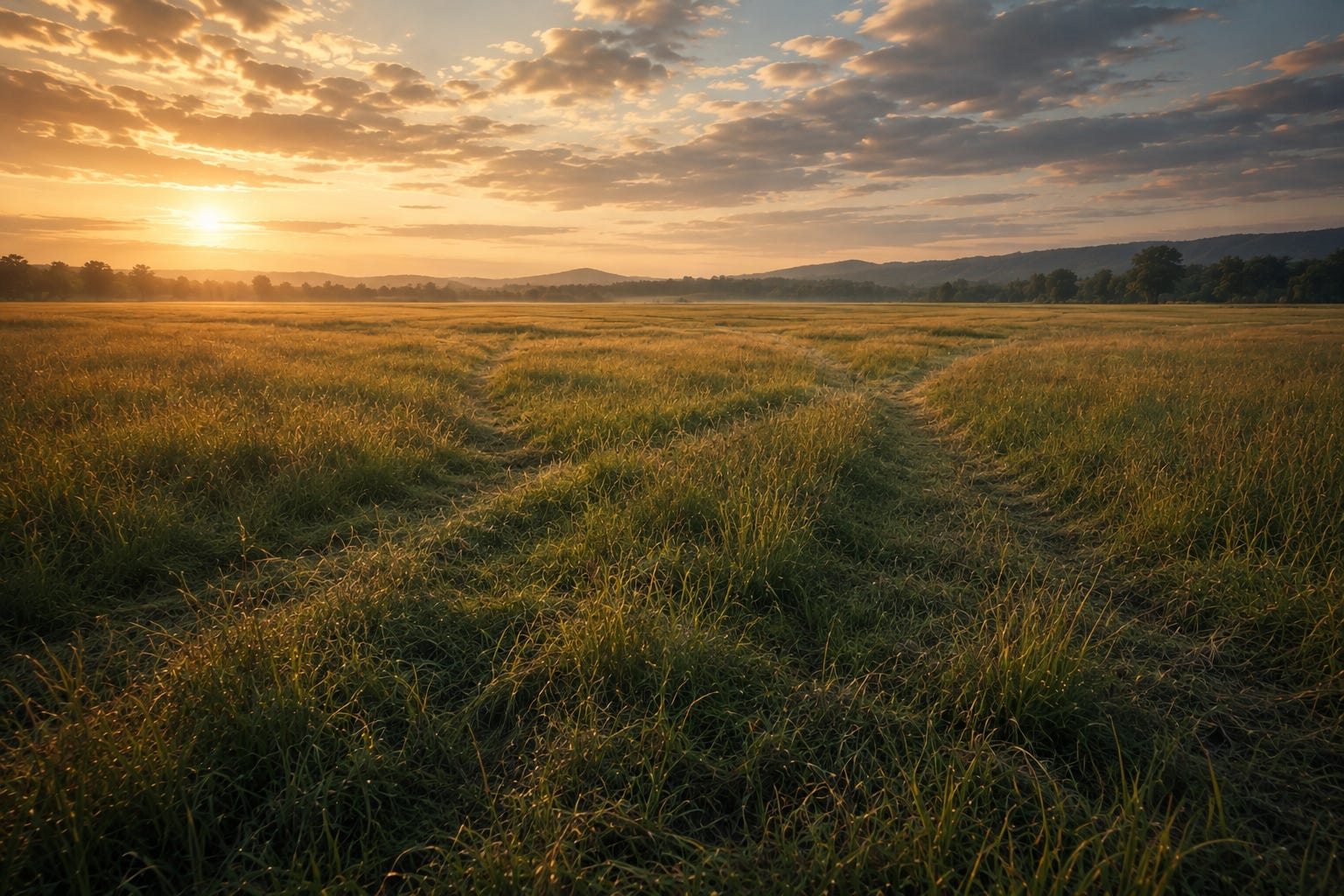
I remember when there were two of you.
You came to me carrying a ball between you, though I never knew what game you intended to play. Perhaps neither did you.
It didn't seem to matter.
You made the rules as you went.
You threw.
You caught.
You missed.
You laughed.
And when the ball escaped one pair of hands, four feet went running after it.
Back then, I knew you both by your footsteps.
Yours crossed mine in long, uneven lines. His met them from the other direction. Again and again you wore paths toward one another until I could have mapped the shape of you from the grass beneath your feet.
Some days one set of footsteps traveled farther.
Some days the other did.
That's what fields are for.
There was room here for tiredness. For mistakes. For dropping things. For standing still while someone else ran.
There was room for both of you to ask:
Are you okay?
And room enough for the answer.
I cannot tell you when it changed.
Fields are good at noticing distance, but terrible at noticing moments.
There was no whistle.
No line appeared in the grass.
No one stopped the game to announce that there would be new rules.
I only know that, slowly, I began to feel one set of footsteps more than the other.
At first, only a little.
A ball would land where his feet had once carried him.
Yours came instead.
Then another.
Yours again.
You ran across me so quickly I don't think you noticed how far you had traveled.
Perhaps that's why you didn't notice that he hadn't.
You were too busy keeping the ball in play.
So I kept the record for you.
Every crossing.
Every retrieval.
Every place you learned to stand so you could reach the next ball faster.
Every inch of yourself you repositioned around the game.
Until one day, I knew you almost entirely by your footsteps.
And him by the places they no longer fell.
By then, I knew the sound of you running.
Not the easy rhythm from before.
This was different.
Quick turns. Sudden stops. The hard press of a foot changing direction before the rest of you had caught up.
You had learned me well.
You knew the shortest distance between almost anywhere and everywhere. You knew which patches of grass would slow you down and where the ground dipped beneath your feet. You learned where to stand between throws so that when the next ball came, you could reach either side of me.
You became very good at the game.
Perhaps too good to notice you were no longer playing the same one.
The balls still came.
That was enough to make everything look familiar.
One would fall near you and you would retrieve it.
One would fall near the center and you would retrieve that too.
One would fall so far across me that once, in the past, another pair of feet would have reached it first.
Still, you ran.
Sometimes I heard you call while you did.
Are you okay?
The question traveled farther than it used to.
Are you okay?
Across the grass.
You asked it after hard throws.
After missed catches.
After silences.
Sometimes even after you had been struck by the ball yourself.
Are you okay?
I remembered when there had been another question here.
It used to travel toward you.
Are you okay?
I don't know when I stopped hearing it.
Perhaps you don't either.
There was no room for it now.
There was always another ball.
And you had become so very good at retrieving them.
I wish I could tell you that I tried to warn you.
But fields cannot speak.
We can only hold the evidence.
And I held yours everywhere.
The grass worn thin beneath the places you had learned to wait.
The long tracks from one end of me to the other.
The places your feet dug in when you turned too quickly.
The patch where you fell once and got back up before you had even decided whether you were hurt.
You didn't have time to decide.
The ball was still moving.
And somewhere in all that running, I began to understand something you had not yet seen.
You were no longer trying to play well.
You were trying to keep the game alive.
Those are not the same thing.
But they can feel exactly the same when you're the one running.
Especially when someone keeps telling you the ball is in your court.
I never understood that.
Perhaps because fields understand distance differently than people do.
I knew where the ball landed.
I felt its weight strike the earth.
Sometimes it landed near your feet.
Sometimes between you.
Sometimes so far from you that reaching it required crossing nearly all of me.
Still:
The ball is in your court.
And still, you ran.
I would have corrected them, if fields could speak.
Not this one.
This one landed over there.
But you were already moving.
Perhaps after a while it stopped mattering where anything landed.
If the game stalled, you restarted it.
If something was dropped, you retrieved it.
If a throw went wild, you chased it.
If someone was hurt, you checked whether they were okay.
Even when the person who was hurt was you.
Especially then.
Because your hurt had a strange way of becoming another ball.
You would try to set it gently between you.
This hurt me.
And somehow, moments later, you would be running again.
Explaining what you meant.
Explaining what you didn't mean.
Reassuring.
Repairing.
Trying to return the game to the moment before you had said you were hurt at all.
I watched this happen enough times that I began to wonder whether you noticed.
Your pain never seemed to stay yours for very long.
It became something else you had to carry.
So you carried it.
What else could you do?
You were still trying to win.
Though I think, by then, winning had changed too.
Once, winning had meant keeping something moving between you.
Now it meant keeping it from ending.
Those are not the same game.
No one had told you that either.
There had been no whistle, no new lines, no announcement.
Only you, running harder under rules you had never agreed to, trying to become good enough at this new game to find your way back to the old one.
Back to four feet crossing me.
Back to laughter in the middle.
Back to:
Are you okay?
Are you?
I remembered that game too.
Perhaps that's why I understood why you kept playing.
But memory is a strange thing on a field.
I can remember every footstep that ever crossed me.
And I can still feel the ones that are crossing me now.
You were playing for what had been.
Your feet were living in what was.
And what was—
was one person running.
One person retrieving.
One person asking.
One person trying to keep the ball in the air.
I could see the whole field.
You couldn't.
You were too busy crossing it.
The ball landed.
You didn't move.
At first, I thought you hadn't seen it.
I had grown so accustomed to the sound of your feet that the silence confused me.
The ball lay where it had fallen.
I waited.
So did you.
Nothing happened.
No one ran.
No one retrieved it.
No one put it back into play.
For the first time in a very long while, the game stopped.
And you were still here.
I wonder if that surprised you.
You had spent so long moving as though everything depended upon the next catch that perhaps you had forgotten what would happen if you simply let something fall.
It fell.
That was all.
The sky remained above us.
The grass moved beneath the wind.
Somewhere beyond my edges, the rest of the world continued without noticing that a ball had stopped rolling.
You stood very still.
Then you looked around.
I had been waiting for you to do that.
Not because I wanted you to leave.
Fields have no use for endings.
We know only what crosses us and what remains.
But I wanted you to see what I had been holding beneath your feet.
The distance.
All of it.
From where you stood, you could see the places you used to wait.
The paths you had worn between one side of me and the other.
The patch of earth where you had fallen and risen before checking whether you were hurt.
The places where two sets of footsteps had once crossed.
And the places where, for a long time now, there had only been yours.
You looked across me.
There was so much field.
I think that was the first time you understood how much of it you had been covering.
You had been too close before.
Too busy running from one end of me to the other to see the shape of the thing you were inside.
But standing still, you could see it.
The whole field.
And in all that sudden quiet, there was finally room for a question.
Not:
Are you okay?
That question had crossed me so many times.
This one was smaller.
So small I almost missed it.
Am I?
You didn't answer immediately.
Perhaps you already knew.
Perhaps you had known for a long time.
Knowing something while running is different from knowing it while standing still.
So you stayed there.
The ball remained where it had fallen.
For once, you let someone else's silence remain someone else's silence.
You let a missed catch remain missed.
You let something be unresolved.
You let the game wait.
And slowly, I felt your weight shift.
I knew that movement.
I had felt it countless times before.
The small lean forward.
The foot preparing to push against the earth.
The body deciding where it needed to go.
I expected you to run toward the ball.
You didn't.
You turned toward the edge of me.
I wish I could tell you that you walked without looking back.
You didn't.
You looked back many times.
At the ball.
At the empty places.
At the paths the two of you had made when the game was still something you played together.
There was love here.
I know.
I held that too.
The laughter was real.
The four feet were real.
The hands reaching toward one another were real.
Whatever came later does not require you to dig those things out of the earth and call them lies.
But neither does what was beautiful require you to keep running through what hurts.
Both things can be true on the same field.
You reached my edge and stopped.
For too long, you had lived as though there were only two directions available to you:
toward the ball,
or toward the other player.
You had forgotten there was another.
Off the field.
You took your mitt with you.
I was glad you did.
There is a difference between putting down something that belongs to you and putting down a game that no longer does.
You did not say you would never return.
You did not need to.
Perhaps someday two sets of footsteps will cross me again.
Perhaps the rules will be spoken this time instead of assumed.
Perhaps something broken here can be repaired.
Perhaps you will discover that some games cannot be returned to, only remembered.
I cannot know.
Fields are good at remembering.
We are terrible at predicting who will cross us next.
I only know what happened that day.
The ball remained where it landed.
No one chased it.
The game you had been keeping alive by yourself finally stopped.
And you walked beyond the place where I could feel your footsteps.
For a while, there was nothing.
Just grass.
Wind.
An abandoned ball.
And all that open space.
I remembered the question you had finally asked while standing on me.
Am I okay?
I could not answer it for you.
But as your footsteps disappeared beyond my edge, I understood something I had not understood while you were running.
Perhaps the first answer did not have to be yes.
Perhaps it was enough that, finally,
you had remembered to ask.
Author’s Note:
Access to AAAV’s Virtual Love Letter and all of the resources I create will always remain free. I believe deeply that neurodivergent people and those who love them should have access to quality, compassionate resources regardless of their financial circumstances.
If this newsletter has helped you understand yourself, your child, your students, or someone you love, I’d like to ask you to consider supporting this work by becoming a paid subscriber.
For $5 a month, you help make it possible for me to continue researching, writing, designing, and publishing these resources while keeping them freely available to everyone who needs them. If you’re able, you can also choose a $100 annual subscription or a $150 Founding Member subscription.
Independent work like this survives because readers decide it’s worth supporting. If you’ve ever finished an article thinking, I’m glad this exists, or I hope Jenn keeps doing this, becoming a paid subscriber is one of the most meaningful ways to help ensure that I can.
Thank you for reading, for sharing my work, and, if you’re able, for helping me continue creating it.
You can also learn more about my commitment to accessibility and how paid subscriptions help sustain this work on my About Me page.
Thank you so much for sharing that this piece touched you. Knowing someone else feels seen makes me feel seen, too. Love coming your way.
This really touched me. I started crying.
I feel really seen by your words. Thank you